This post is aimed at people who like to give advice on how someone needs to change, then walk away like Dynamo after a trick, leaving the victim dazed and confused.
So yes, this is aimed at pretty much all of us!
Here are some of my personal favourites….
- You’re far too soft…
- You’re far too harsh…
- You’re vanilla…
Normally followed by
- You need to be tougher!
- You need to be more understanding!
- You need a flake and strawberry sauce!
Thanks Dynamo! It’s all so f#$!king clear now! You should write a blog post.
Here’s the problem with this approach, even when delivered with the best of intentions…
This often results in an individual taking the advice, abandoning their current approach, and turning from Ned Flanders to Cruella Deville in two shakes of a monkey’s tail.
In the example of being called too soft, they take it personally and make a deal with the devil to change. The problem is this becomes inauthentic and they melt faster than Hell-boy with a mini-milk.
Time to Introduce Hardware & Software into the mix.
When the above happens, you almost certainly have not considered the hardware and software capability of the individual prior to giving your command to them!
Read on and I will explain further…
When you were born, we were each given attributes by Mother Nature… height, strength, size, looks etc… Let’s call this our visible hardware.
As we develop, every time we do something our neural pathways build. The more we repeat the behaviour the stronger the connection. That’s why whatever you practice you become better at.
As the connections strengthen, it is like have a high speed fibre connection in your brain, rather than a copper ASDL dial up connection.
Research suggests that by the age of 14 our basic connections are formed and our default characteristics are set for life e.g. Introvert/ Extrovert. This is our default map of the world.
Like RAM memory in a computer let’s call this our invisible hardware.
As we navigate through adolescence, we learn a myriad of coping mechanisms to function productively in school, work and personal environments. Some we are naturally comfortable with, other less so. Let us call this our software.
Let’s use a quick picture to clarify this, and introduce you to Silly’s 3 T’s – Talent, Traits & Toolbox.

Talent is the person’s natural aptitude. They say world class footballers are world class because they do not have to think, they just act!
A Trait is a quality or characteristic, belonging specifically to that person and normally related to their map of the world.
A Toolbox is a container to store all the tools and coping mechanisms you have at your disposal – all with a specific purpose to pull out to complete a job or task.
What I am advocating is to think about the above prior to giving any feedback, then consider the following approach…
- Highlight the strength of the individual’s talents and traits. Make sure they celebrate what they are strong at, not having to abandon years of development. This keeps the hardware running smoothly.
- Focus on helping them continually build their toolbox. A toolbox in leadership terms may be an approach for the person to try, often outside their comfort zone. This continually adds new software for new challenges. We all want a bigger toolbox don’t we!
- Stop categorising people as hard, soft, weak, strong etc.. Instead work together non emotionally to identify how they can build their capability toolbox. It is important this compliments their existing hardware, not at the expense of it.
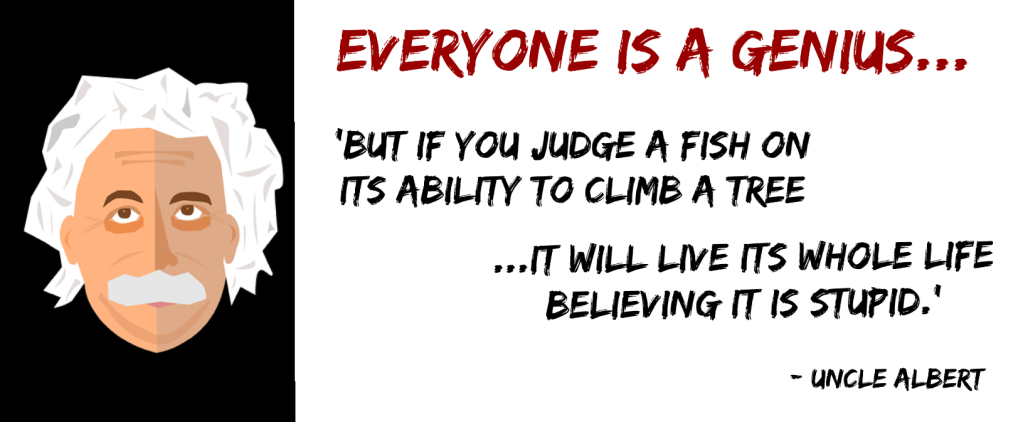
Place your focus on better, not perfect. Give this a whirl, and as Albert says…