It’s not unusual to use the word stress and associate it with negative scenarios, often bad for our health and wellbeing.
How often have you heard the term ‘Don’t get stressed man!’
This post is therefore aimed at looking a bit deeper into the different types of stress, to understand it better and the impact on performance…
Who better to help than everyone’s favourite Welsh legend Sir Tom Jones. He certainly knows the score lol…
As Tom says ‘It’s a hard one‘. Wise words indeed…
If a quick two minutes with Tom is all you need, quit this post now….If not read on…
With the help of Sir Tom and some emojis, I want to explore the 4 stages on the Stress Bomb Stress Bomb scale. (Bet ya sang that!)
Here is the scale. Let’s look at the 4 stages in turn and explain….
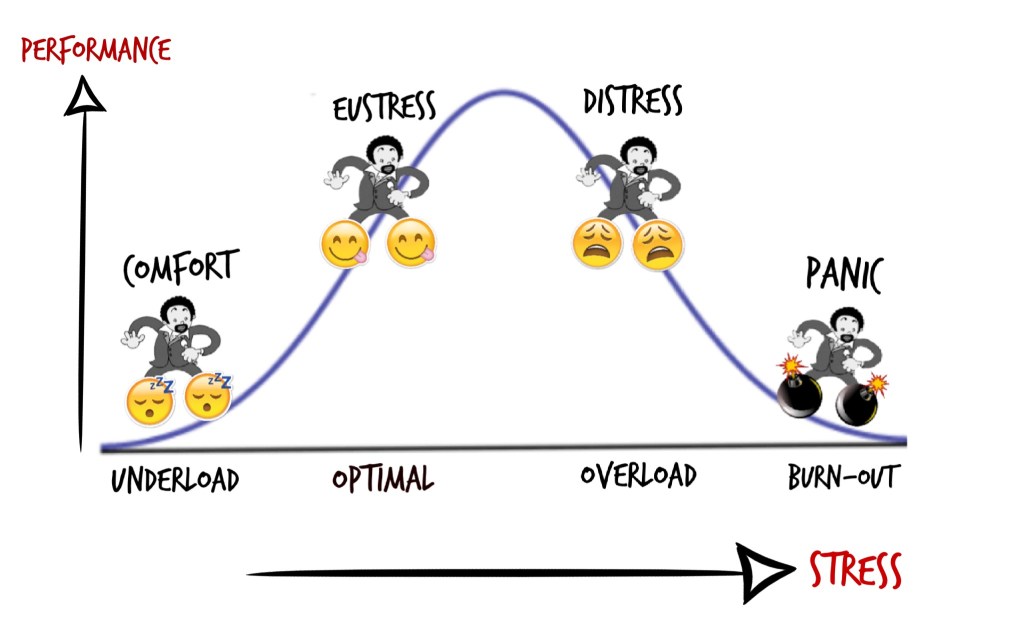
- Comfort. This is where you are completely in order and not stretching your potential. This is a relaxing place to be, but the long term reality is that you are not growing. This is likely to lead to stagnation and decline.
- Eustress. This is good stress where you feel safe, confident, passionate and energetic, usually focussed on achieving something special. This is where you hit your optimal performance levels.
- Distress. This is where you have too much pressure and task, leading to overload. This results in a decline in performance. Remember, overload could be affected by your work or personal environment.
- Panic. This is where the overload turns to burnout and you are extremely stressed. In this place, performance really suffers.
So, it is pretty clear to understand these 4 stages. In fact, we have probably experienced them all at some time or another.
Let’s now build on the 4 stages with a simple coping mechanism when you see performance decline.
Importantly, it allows you to stop and assess a situation before deciding whether to apply or reduce challenge to any underperformance. Doing this, helps maintain trust within your working relationships.
Imagine a pressure gauge sitting over the 4 stages on the Stress Bomb scale…
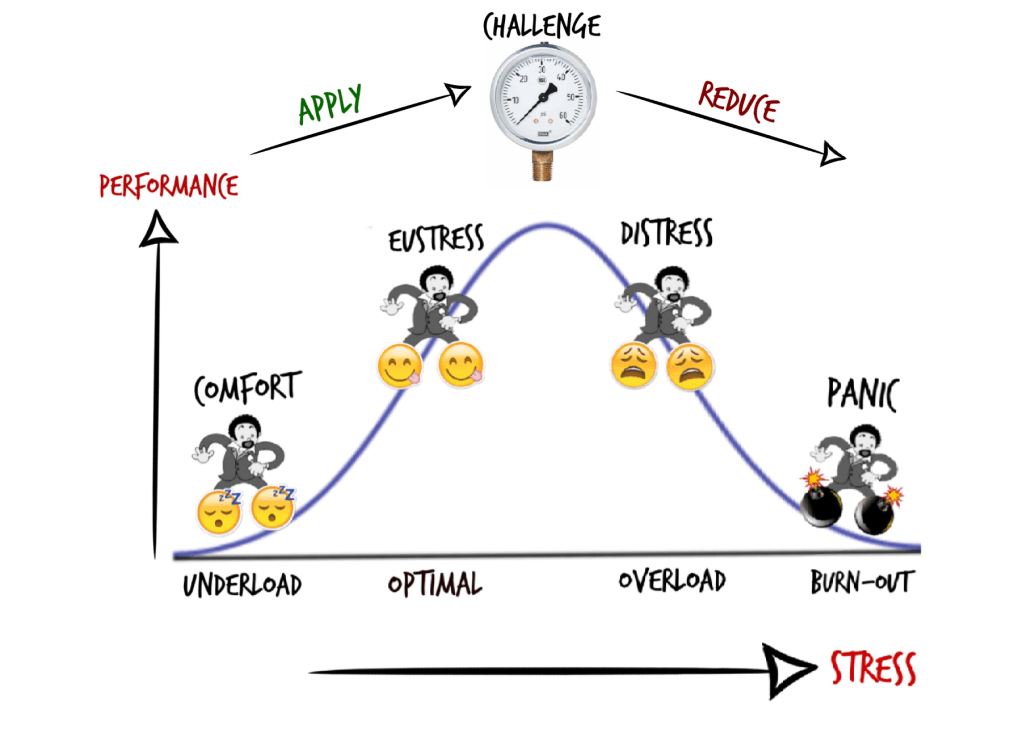
This simply allows you to gauge the current position of either yourself or a member of your team and decide whether to apply or reduce challenge.
Ever heard the saying some people need a foot up their arse and others need an arm around their shoulder…
Well it’s pretty much the same, but you do not associate with a fixed view of an individual, more a fluid assessment of where they are any given time.
If in underload, Apply Challenge, if in overload or panic Reduce Challenge.The secret is to spend as much time in eustress as you can.
The final caveat to this post is that if someone is spending the majority of their time in distress or panic, and you are providing a safe and supportive environment, then as Sir Tom rightly advises, they probably need to find a career where they will be happier.