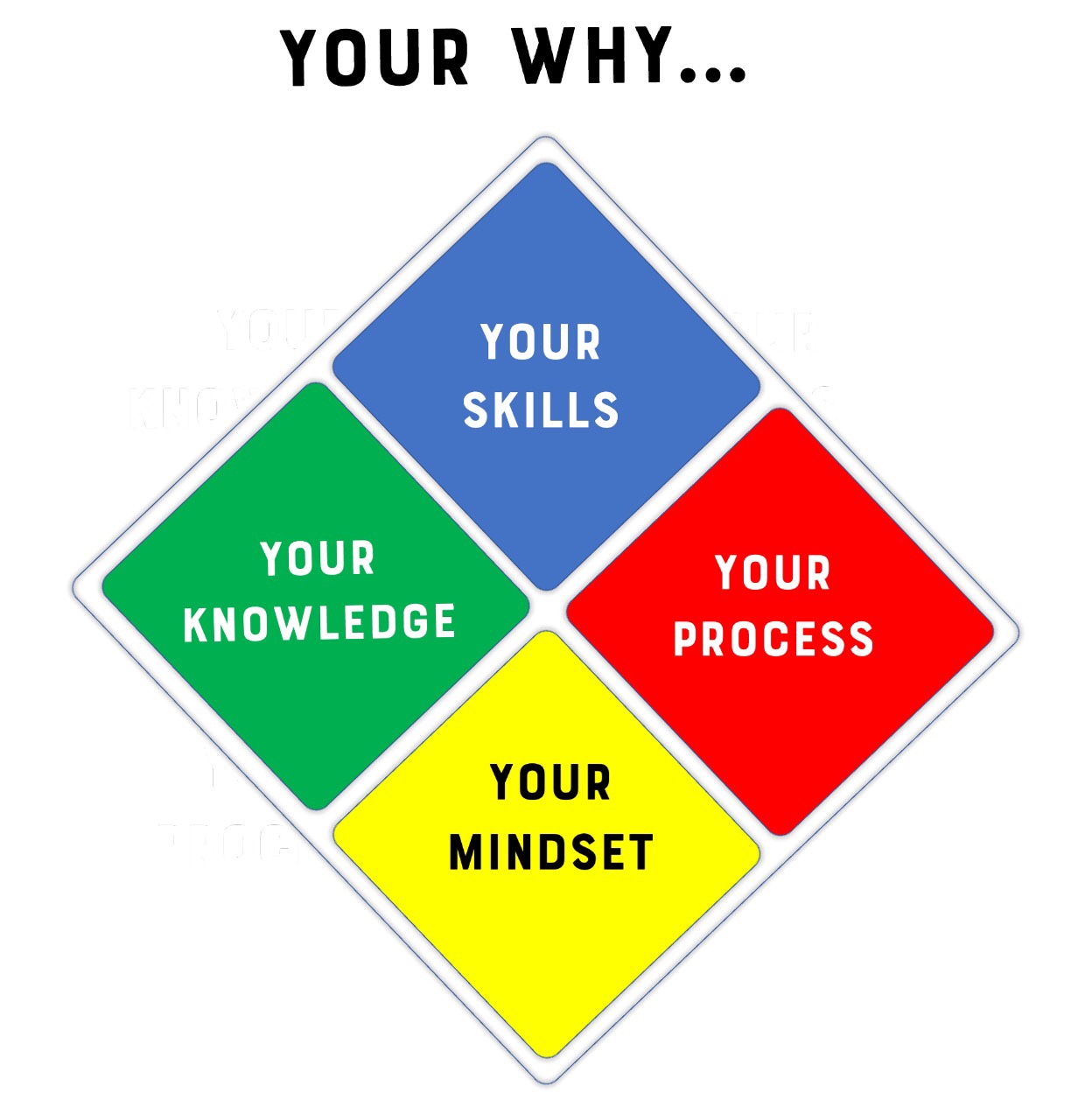
I first saw this formula several years ago and it was delivered to me as an excellence formula. I am not personally a fan of labelling it as excellence and would like you to consider it more of an improvement formula.
I am a firm believer in focussing on better rather than perfection. Better is always the most productive next step. The formula below helps identify 4 component parts you can use to unlock then unleash targeted improvement

Let’s look at each of the component parts in turn…… Think about something you want to get better at. As an example, let’s imagine you work in sales and have decided to improve at selling a new mountain bike. You could use this formula to assess yourself on the following areas..
- Knowledge – What is my product knowledge like? How does it relate to other comparable bikes? How much does it cost? etc……
- Skill – How does it fit into my current sales cycle? What’s the great questions to ask a customer? What’s my pitch? How can I overcome potential objections? etc…
- Process – How do I process the sale? What P&P do I need to cover? How good am I at the systems needed? etc….
- Mindset – How dedicated, focussed and passionate am I around getting better? etc….
Why is Mindset outside of the brackets?
Mindset is everything and without it you will not have the impetus to improve….. the maths of the formula back this up….. imagine a scale on each variable of 1-10


- How will you discipline yourself to focus on the more infinite approach of getting better instead finite definitions of success?
- if you rate yourself against the improvement formula on a scale of 1-10 there is a perfection score of 300 (10+10+10)x10. If you start from an average rating of 5 that would generate a score of (5+5+5)x5 = 75. This means you are only 25% to perfection. Sounds Depressing.
- Therefore focus on getting better. Simply shifting knowledge, skill and process up by 1 and mindset by 2 would mean (6+6+6)x7) = 126. A 68% improvement is much more inspiring than 42% to perfection.
- Pick something you want get better at and analyse against KSPM. Then focus on the next step for each area. Then you simply Eat-Sleep–Repeat
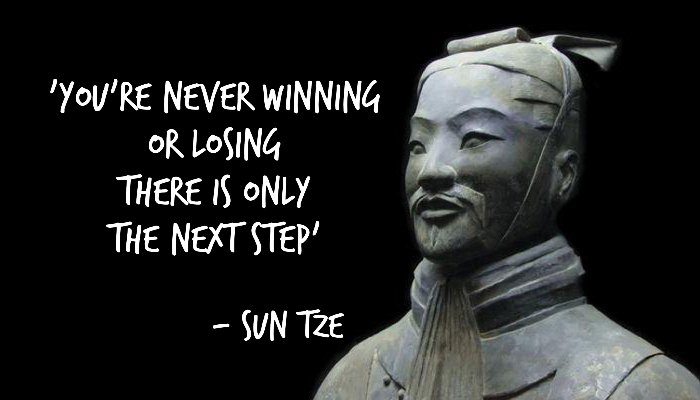
This quote sums the essence of this post up perfectly. It is my interpretation of a strategic pillar from Sun Tze’s Art of War
 Most businesses today operate to a Balanced Scorecard measurement system covering commercial, operational, people and customer metrics. This is used to get an overall picture of the whole business and look at the relationships of different priorities on overall performance.
Using a similar approach you could think about your personal development using the Balanced YourCard. Your Why is your reason to improve and you can use the 4 section of Knowledge, Skill, Process and Mindset to build a full picture of your overall capability